Geneva, 10 November 2025 – Today marks a major milestone in the global fight against wildlife crime, as the International Consortium on Combating Wildlife Crime (ICCWC) celebrates its 15-year anniversary.
To understand the significance of this moment, it is worth reflecting on how far the global community has come since 2010.
The beginning of the partnership
In 2010, the heads of five intergovernmental organizations with specialized yet complementary mandates came together to sign the Letter of Understanding Establishing the International Consortium. This historic step brought together the Convention on International Trade in Endangered Species of Wild Fauna and Flora (CITES) Secretariat, the International Criminal Police Organization (INTERPOL), the United Nations Office on Drugs and Crime (UNODC), the World Bank, and the World Customs Organization (WCO), establishing a unified front against wildlife and forest crime.
Since its establishment, ICCWC and its partner organizations have supported over 130 countries and their national authorities to strengthen criminal justice systems and provide coordinated, technical, and operational support to combat wildlife and forest crime worldwide.
15 years, 15 achievements
To commemorate this anniversary, ICCWC has launched a series of materials highlighting its journey and achievements.
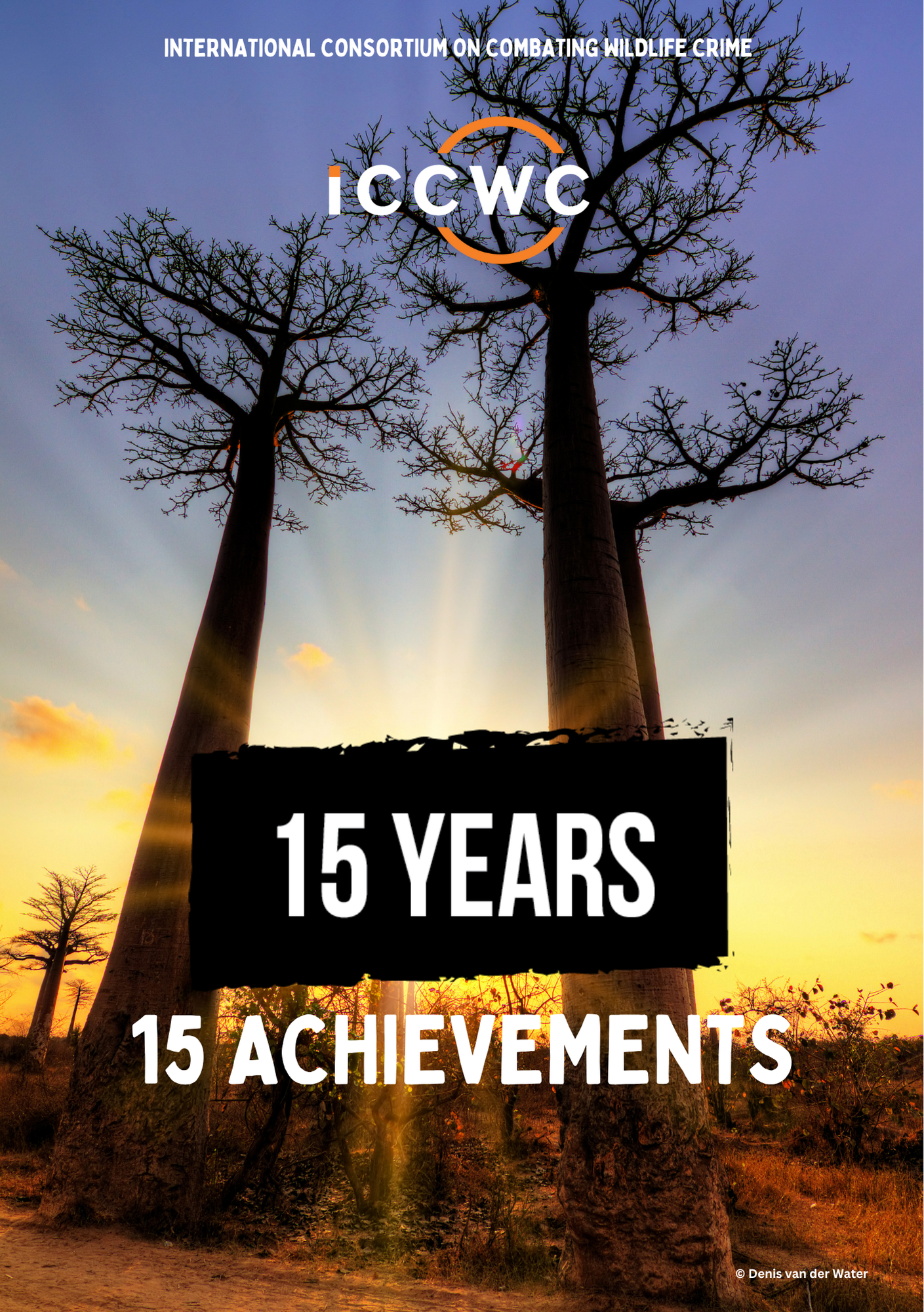
The new publication, “15 years, 15 achievements” brings readers through 15 examples of ICCWC’s work. From the impact of ICCWC flagship tools, to recognition in United National General Assembly (UNGA) Resolutions, to work across forensics, financial crime, law enforcement operations and intelligence exchange, this publication tells the story of how Parties have strengthened their criminal justice systems. By doing so, ICCWC support ensures global biodiversity is preserved while bringing those responsible for wildlife crime to justice.
A digital timeline illustrates key milestones, events, and developments in ICCWC’s history, highlighting the Consortium’s continued impact and the importance of collective global action.
Fifteen years of milestones and impact
Numerous milestones have been achieved which have helped shape the global response to wildlife crime by ICCWC. Among the highlights, key impacts include:
Launching flagship tools
Since 2012, the ICCWC Wildlife and Forest Crime Analytic Toolkit and the ICCWC Indicator Framework for Combating Wildlife and Forest Crime, have guided over 20 countries in assessing and strengthening their national responses. The ICCWC Guidelines for Wildlife Enforcement Networks (WENs) has become a valuable resources for WENs to evaluate their operational performance and identify areas that could be further strengthened.
Recognition of ICCWC’s pivotal role by the United Nations General Assembly (UNGA)
Over the past decades, wildlife crime has risen steadily on the global agenda, leading to increasing recognition of ICCWC. Most recently, a 2025 UNGA Resolution reaffirmed this commitment, highlighting ICCWC’s vital role in providing technical assistance to countries worldwide. These milestones have been transforming how the world responds to wildlife crime. Governments are increasingly treating it as serious transnational organized crime, mobilizing greater political will, funding, and inter-agency cooperation.
Supporting a series of CITES species-specific task forces
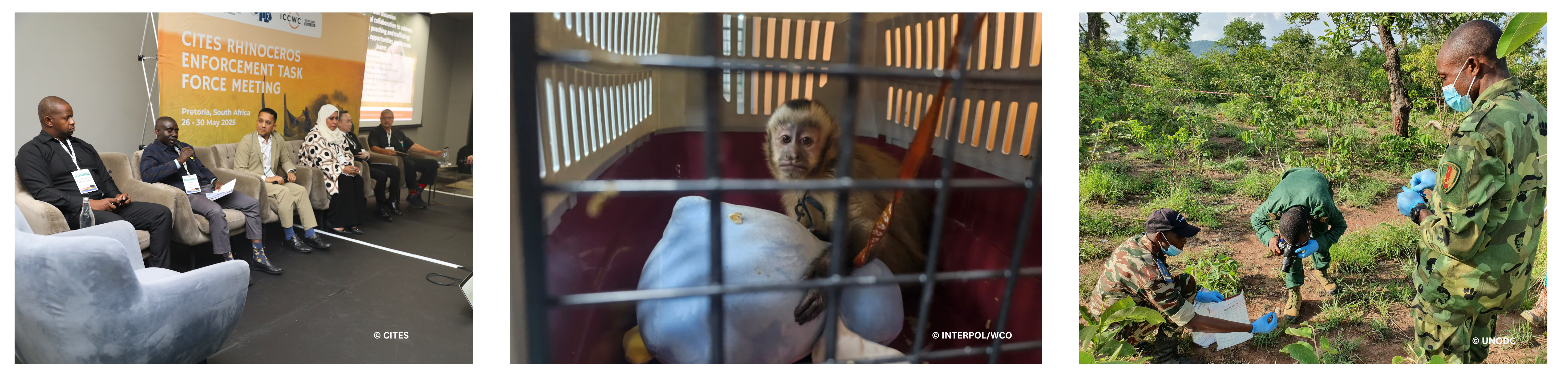
ICCWC has supported six CITES task force meetings including on rhinoceros, tortoise and freshwater turtles, tree species, and big cats. These meetings have brought together over 250 global participants and have been key to facilitate intelligence exchange, coordination, and enforcement action on these priority species.
The launch of the “Thunder” series of global enforcement operations
Thunder Operations have brought together agencies across continents to disrupt criminal networks, recover trafficked wildlife, and dismantle supply chains. These operations have led to thousands of seizures and arrests, demonstrating the power of coordinated international action. In 2024, the Operation led to the seizure of nearly 20,000 wild animals and 365 suspect arrests.
Establishment of the Wildlife Inter-Regional Enforcement (WIRE) Forum
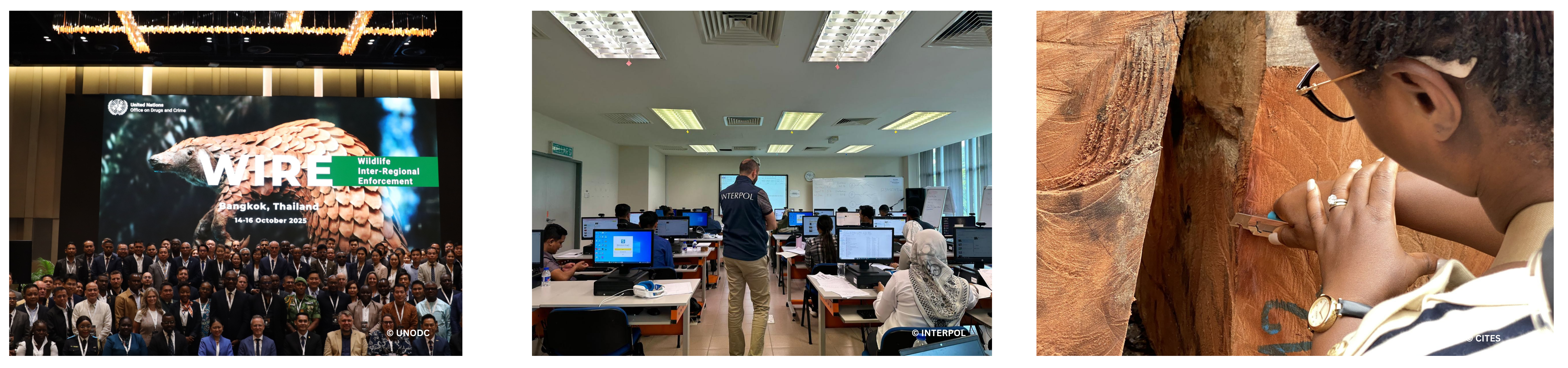
ICCWC has supported nine WIRE Forums to date involving over 30 countries. These meetings have fostered regional cooperation and information sharing between enforcement networks and international collaboration through informal networks, working groups and 200 restricted access meetings between government officials. The Forum has also led to over 30 transnational investigations on wildlife crime cases.
Development of tailored guidance and tools
ICCWC partners have developed a range of tailored tools, resources and guidance to support frontline law enforcement officers in legal and investigative techniques, cybercrime and financial investigations linked to wildlife crime.
- Rapid Reference Guides (RRGs) have supported frontline officers and prosecutors in applying effective legal and investigative techniques. They promote a consistent, methodical approach across agencies, fostering close coordination among stakeholders. ICCWC has supported 13 countries and 3,235 investigators and prosecutors across East Africa alone in the development of and training on RRGs.
- As illegal wildlife trade has increasingly moved online, with traffickers using social media, e-commerce, and encrypted messaging apps, ICCWC has helped authorities address this growing challenge. This included support with developing guidance for law enforcement practitioners and corresponding trainings and workshops.
- Traffickers launder billions of dollars every year through complex financial systems, disguising illegal proceeds as legitimate income. To tackle wildlife crime from this angle, ICCWC has supported the development of specialized tools on anti-money laundering and financial investigations, enabling authorities to follow illicit financial flows associated with wildlife crime.
20th World Wildlife Conference - CITES CoP20
In the upcoming 20th meeting of the Conference of the Parties to the Convention on International Trade in Endangered Species of Wild Fauna and Flora (CITES CoP20), ICCWC will host three side events focusing on cooperation, the use of data to inform enforcement action, and forensics. More details will be announced closer to the event on this page.
Recognition of crucial donor support
On behalf of the over 130 countries that ICCWC has supported over these 15 years, ICCWC acknowledges with deep gratitude the donors that have made the Consortium’s work possible since 2015:
- European Union
- France
- Germany
- Principality of Monaco
- Netherlands
- Norway
- Sweden
- United Kingdom of Great Britian and Northern Ireland
- United States of America
- The Global Environment Facility (GEF)
Looking ahead
ICCWC’s work is fundamental to achieving a world free of wildlife crime. Each of its five partner organizations has a mandate from their member countries to address aspects of this challenge; from enforcement and customs cooperation to financial integrity and legal frameworks. Through ICCWC, these partners bring their unique strengths together to help countries meet their international commitments, strengthen the rule of law, and safeguard our planet’s natural heritage. Looking to the future, ICCWC will continue to evolve and adapt to emerging threats, ensuring that countries have the support they need towards a world free of wildlife crime.